
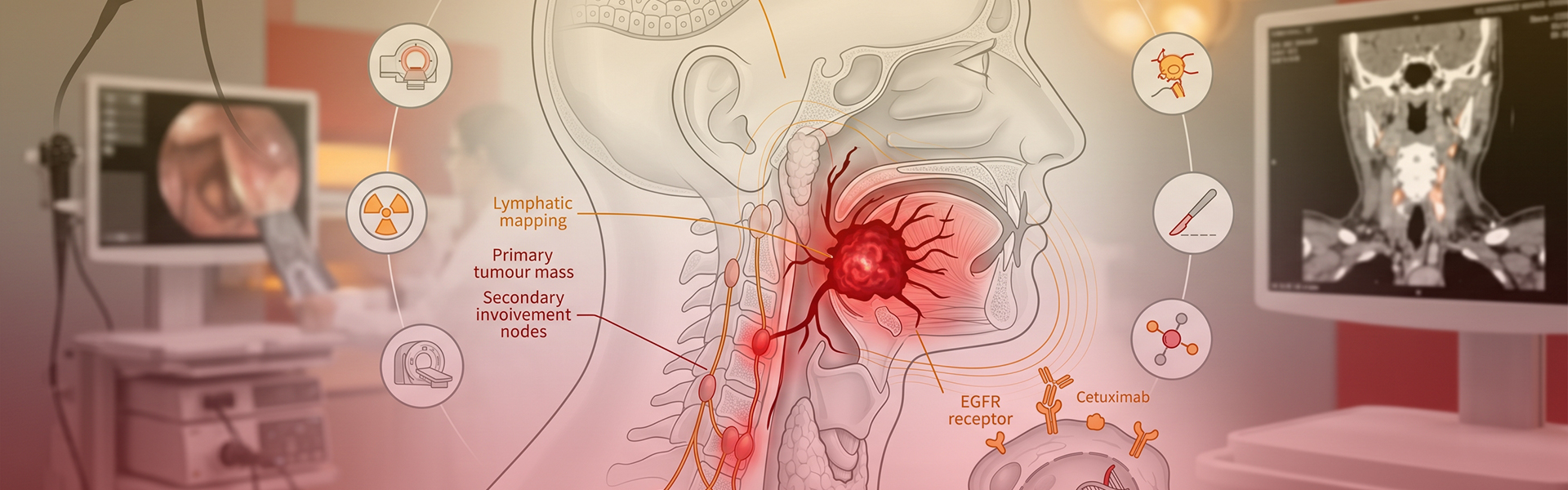
Head and neck cancers encompass a range of malignancies affecting the mouth, throat, voice box, sinuses, and salivary glands. Early diagnosis and specialised treatment play a crucial role in improving survival rates and quality of life.
India has one of the highest rates of head and neck cancer in the world. Oral cancer ranks in the top 3 cancers for Indian men. In Gujarat specifically, tobacco habits (gutka, pan masala, khaini, bidi) are the leading cause. The tragedy is that most cases are diagnosed at Stage III or IV, when treatment becomes much harder. Caught early, survival rates are very high.
Oral cancer: Affects the lips, tongue, gums, and inner lining of the cheeks, and is most common in India
Understanding what causes head and neck cancers helps you and your family take preventive action
Warning signs — Do not ignore these Visit a doctor immediately if you notice any of these signs lasting more than 2 weeks
THE 2-WEEK RULE: Any symptom in the mouth or throat lasting more than 2 weeks must be evaluated by a specialist, especially if you use tobacco in any form.
Our multidisciplinary team provides specialised care combining surgery, radiation, chemotherapy, and reconstruction to deliver the best possible outcomes, including voice and function preservation wherever possible.
Used for early-stage cancers of the base of the tongue, tonsils, posterior pharyngeal wall, and soft palate. The tumour is removed through the mouth with no external cuts, preserving appearance and function.
Minimally invasive robotic procedures for the precise removal of thyroid and parathyroid glands, resulting in reduced scarring, less pain, and faster recovery.
A minimally invasive approach to remove cancer-affected lymph nodes in the neck with enhanced precision and improved cosmetic results. The procedure leaves no visible scar on the neck.

Not necessarily. At KD Cancer Centre, voice-box preserving (laryngeal preservation) surgery is offered wherever possible. Our speech therapy team supports voice rehabilitation. The goal is always to maintain your quality of life.
Yes, absolutely. Many early-stage oral cancers have NO symptoms at all. Any long-term tobacco or gutka user should have a mouth examination at least once a year. The earlier we find any change, the easier it is to treat.
In many cases, yes. It depends on the type of treatment and your overall health. Your doctor will guide you based on your condition.
Not necessarily. The aim of cancer surgery today is not only to remove the disease but also to preserve appearance and function as much as possible. Advanced surgical techniques and reconstructive procedures help minimise visible changes. Your doctor will discuss the best approach to ensure both effective treatment and a good cosmetic outcome.
In many cases, yes. It depends on the type of treatment and your overall health. Your doctor will guide you based on your condition.
No. Only a small number of cancers are linked to family history. Most are related to lifestyle and environmental factors.
© KD Cancer Centre. All Rights Reserved.