
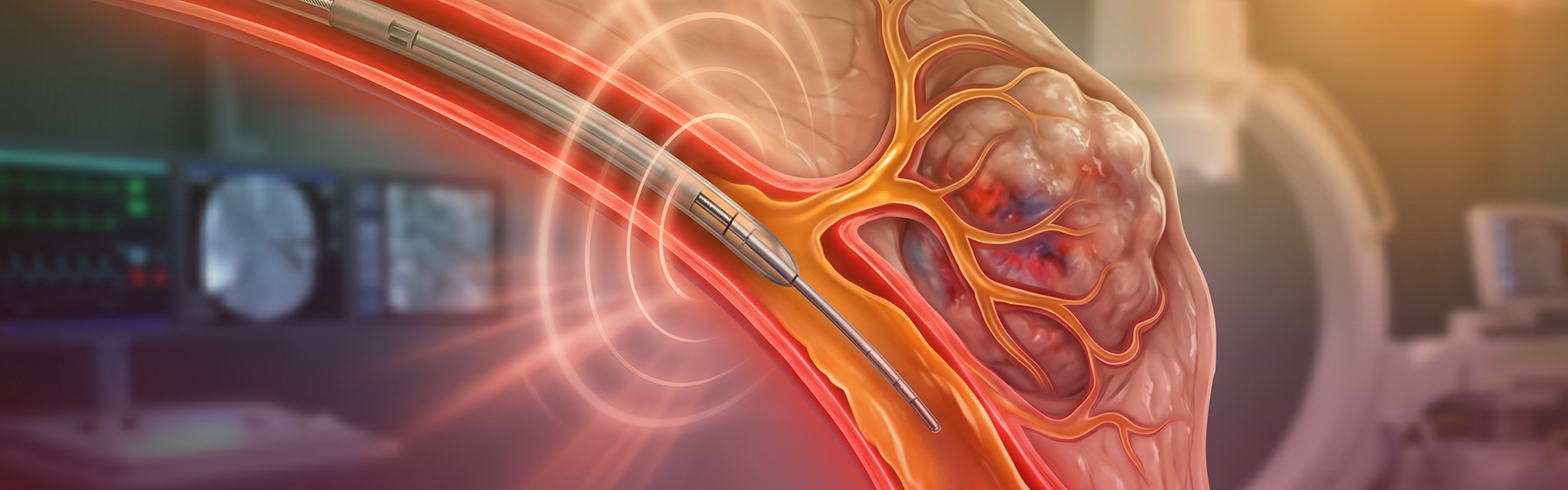
Interventional radiology (IR) is an advanced speciality that combines imaging technology with minimally invasive procedures to diagnose and treat a wide range of medical conditions, including many cancers and cancer-related complications. At KD Cancer Centre, our Interventional Radiology team uses real-time imaging techniques such as X-rays, ultrasound, CT scans, and MRI to guide specialised instruments precisely to the area requiring treatment.
Often described as pin-hole surgery,interventional radiology allows treatment through tiny skin punctures rather than large surgical incisions. Using fine wires, catheters, and needles, our specialists can access organs, tumours, and blood vessels deep inside the body with remarkable accuracy.
This advanced approach offers effective treatment with less pain, quicker recovery, and shorter hospital stays.
Many IR procedures are performed under local anaesthesia with or without mild sedation. For vascular procedures, access is commonly gained through the femoral artery or vein in the groin using a tiny puncture. Guided by live imaging (fluoroscopy), catheters and guidewires are carefully advanced to the target area.
Contrast dye may be used to visualise blood flow and identify abnormal vessels, tumours, bleeding points, or blockages. Once the problem is identified, treatment can often be delivered immediately through the same catheter.
Patients increasingly benefit from IR because it offers
Used for
A minimally invasive alternative to hysterectomy for
Used to control haemoptysis (coughing up blood), often caused by chronic lung disease or tumours.
Performed for selected cases of hypersplenism and related blood disorders.
Cancer-focused liver interventions
Trans arterial chemoembolisation (TACE)
An advanced treatment for non-operable intermediate-stage liver cancer (Hepatocellular carcinoma).
Chemotherapy-loaded beads are delivered directly into the artery feeding the tumour, allowing
Trans arterial radioembolisation (TARE)
Radioactive microspheres are delivered directly into the tumour’s blood supply to provide highly targeted internal radiation treatment.
Performed before surgery for highly vascular tumours to reduce bleeding risk during the operation.
We offer minimally invasive treatment for narrowed or blocked veins and arteries, including
Balloon angioplasty and stent placement help restore blood flow and relieve symptoms.
Transjugular liver biopsy
A safer liver biopsy technique for patients with bleeding risk, ascites, or complex liver disease.
Venous sampling for endocrine tumours
Highly specialised procedures including
These tests help accurately localise hormone-secreting tumours.
Using Ultrasound or CT guidance, tissue samples can be safely obtained from suspicious lesions for accurate diagnosis.
Placement of drainage tubes for
Ultrasound-guided nerve blocks
Used for cancer pain management and chronic pain relief.
Radiofrequency ablation (RFA)
Heat generated by radiofrequency energy destroys tumour tissue.
Microwave ablation (MWA)
Microwave energy is used to treat selected tumours quickly and effectively.
Suitable for selected
Biliary interventions
Percutaneous transhepatic biliary drainage (PTBD)
Used to relieve obstructive jaundice caused by tumours or biliary blockages.
Biliary stenting
A stent is placed to restore bile flow and improve liver function.
At KD Cancer Centre, our interventional radiology services are integrated with oncology, surgical oncology, medical oncology, radiation oncology, gastroenterology, hepatology, and critical care to provide comprehensive treatment planning.
We combine
Interventional radiology can treat a wide and ever-growing range of conditions, and has become an essential part of contemporary healthcare.
© KD Cancer Centre. All Rights Reserved.