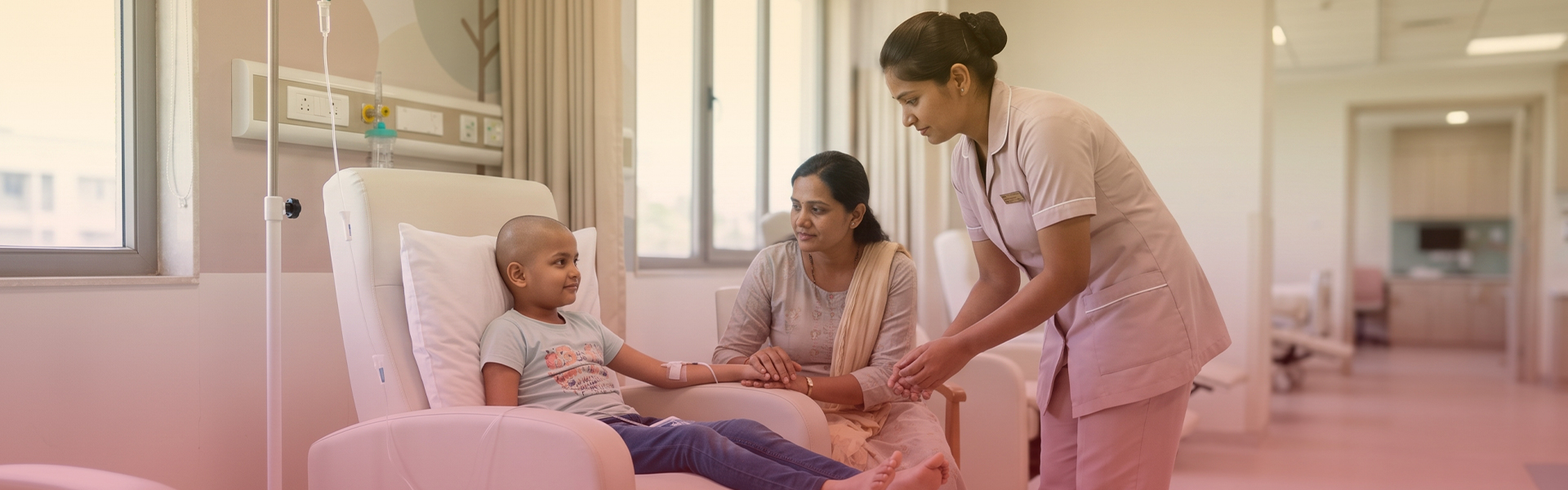
A child being diagnosed with cancer is one of the most devastating moments a family can face. At KD Cancer Centre, our Paediatric Oncology team combines clinical excellence with a child-centred environment and deep family support, because children are not small adults, and their cancer care must be designed specifically for them.
India faces unique challenges in childhood cancer care that make specialist centres like KD Cancer Centre essential
of childhood cancers in India are leukaemia — the most common
ALL survival improvement in India with modern protocols
of world's childhood cancers occur in low-to-middle income countries
bias — boys more commonly brought for treatment than girls in India
Source: Tata Medical Centre / ICICLE data
Key challenges specific to India: treatment abandonment (families stopping treatment due to cost, distance, or loss of hope); delayed diagnosis; gender bias in seeking healthcare (boys more often brought for treatment than girls); and inadequate access to paediatric oncology specialists in smaller cities. KD Cancer Centre addresses all of these through specialised care, financial counselling, and family education.
Childhood cancers are biologically distinct from adult cancers. This distinction underscores the necessity for specialised paediatric oncology care and reinforces that children should be treated by dedicated paediatric oncology teams rather than adult cancer services.
Different tumour types: Leukaemia, Wilms tumour, neuroblastoma, and retinoblastoma almost exclusively occur in children, not adults.
Different biology: Most childhood cancers arise from developmental tissue and grow very rapidly, but this also makes them much more sensitive to treatment.
High cure rates: Over 80% of children with cancer in well-resourced settings achieve long-term cure; even in India, cure rates are improving dramatically.
Different drug doses: Chemotherapy doses, frequencies, and protocols in children are completely different from adult protocols.
Long-term effects matter;children are still developing; treatment must be designed to minimise late effects on growth, fertility, heart, brain, and bone.
Emotional impact on the whole family: Siblings, parents, and grandparents all need support, not just the child.
Leukaemia is by far the most common childhood cancer in India. Acute lymphoblastic leukaemia (ALL) is the most common type and is one of the great success stories of modern medicine, cure rates have improved from under 20% in India two decades ago to over 70–80% with modern risk-adapted chemotherapy protocols.
ALL (Acute Lymphoblastic Leukaemia): Most common; curable in 70–80% with modern protocols in India
AML (Acute Myeloid Leukaemia): Requires more intensive treatment; cure rates 40–50%
CML (Chronic Myeloid Leukaemia): Managed with oral targeted therapy (Imatinib); excellent outcomes
Brain tumours are the most common solid tumour in children. Types include medulloblastoma, astrocytoma, ependymoma, germ cell tumour, and DIPG (diffuse intrinsic pontine glioma). Treatment requires specialist neurosurgery, radiation, and chemotherapy, with careful attention to preserving brain function.
Hodgkin's lymphoma is one of the most curable cancers in children, with cure rates exceeding 90% with modern ABVD/BEACOPP chemotherapy. Non-Hodgkin's lymphoma in children behaves differently from adult NHL and requires paediatric-specific protocols.
A cancer of the sympathetic nervous system, most common under the age of 5. Presents with abdominal mass, fever, and weight loss. Staging determines treatment — surgery alone for localised disease; complex multi-agent chemotherapy, surgery, radiation, and immunotherapy (Dinutuximab) for high-risk disease.
A kidney tumour occurs almost exclusively in young children (peak age 3–4 years). Usually presents as an abdominal mass. Highly curable, over 90% of localised Wilms tumours are cured with nephrectomy and chemotherapy. Pre-operative chemotherapy with the SIOP protocol is standard practice.
Osteosarcoma (the most common primary bone cancer in children and adolescents) and Ewing sarcoma both require multi-agent neoadjuvant chemotherapy followed by surgery (limb-salvage whenever possible) and adjuvant chemotherapy. Limb salvage is now achievable in 80–90% of cases.
A cancer of the retina occurring in infants and young children. The most common eye cancer in children. White pupil reflex ('cat's eye' appearance) or squint in a young child should prompt urgent ophthalmology referral. When diagnosed early, the eye can often be saved. Treatment involves intra-arterial chemotherapy, laser therapy, cryotherapy, or enucleation for advanced cases. All children with retinoblastoma should have genetic testing.
Children cannot always describe their symptoms. A parent's instinct matters. If something seems wrong and does not resolve within 2 weeks, insist on a specialist assessment. Most warning signs in children are caused by infections, but a small number indicate cancer, and catching that small number early is life-changing.
Blood tests and bone marrow examination (bone marrow aspirate and trephine biopsy) — for leukaemia diagnosis
Lumbar puncture (CSF analysis): For CNS leukaemia assessment
Imaging: MRI, CT, PET-CT, bone scan: For solid tumours and staging
MIBG scan: Specific for neuroblastoma staging
Tumour markers: AFP, beta-hCG, LDH, NSE, Ferritin, for germ cell tumours, neuroblastoma
Molecular and genetic testing: FISH, NGS, cytogenetics, critical for risk stratification and treatment protocol selection
Biopsy and pathology: With paediatric-specific pathology reporting
Chemotherapy: Paediatric-specific protocols (ALL-BFM, SIOP Wilms, COSS for osteosarcoma, Euro-Ewing); dosing calculated by body surface area; age-specific adjustments
Surgery: Limb-salvage surgery for bone tumours; nephrectomy for Wilms; tumour resection for neuroblastoma
Radiation therapy: Precision techniques to protect developing organs and brain; proton beam therapy for CNS tumours when available
Targeted therapy: Imatinib for CML; Crizotinib/Alectinib for ALK+ tumours; Vemurafenib for BRAF+ histiocytosis
Immunotherapy: Dinutuximab for high-risk neuroblastoma; checkpoint inhibitors for selected adolescent cancers
At KD Cancer Centre, we understand that treating a child with cancer means supporting the entire family. Our support services include
Child life specialists: To help children understand their illness and cope with procedures through age-appropriate play and activities
School reintegration support: Helping children return to school during and after treatment, including teacher education
Psychological support for parents: Individual and group counselling; peer support from other families
Outstation family support: Accommodation guidance for families travelling from outside Ahmedabad
Nutrition: High-calorie paediatric meal plans; guidance for managing chemotherapy-related eating difficulties in children
Childhood cancers are biologically distinct from adult cancers, requiring different treatment protocols, drug dosing, and supportive care. Paediatric oncology teams are specifically trained to manage these differences and minimise long-term complications.
The most common childhood cancers include leukaemia (especially ALL), brain tumours, lymphomas, neuroblastoma, Wilms tumour, bone tumours (osteosarcoma and Ewing sarcoma), and retinoblastoma.
Persistent fever, unexplained bruising or bleeding, pallor, lumps or swelling, bone pain, white reflex in the eye, persistent headaches with vomiting, and enlarged lymph nodes should raise suspicion and warrant evaluation.
Yes. With modern treatment protocols, over 80% of children with cancer can achieve long-term cure in well-resourced settings, and outcomes in India are steadily improving.
Diagnosis involves a combination of blood tests, bone marrow examination, imaging (MRI, CT, PET-CT), biopsy, and advanced molecular and genetic testing for accurate classification and treatment planning.
Chemotherapy in children is carefully calculated based on body surface area and developmental stage. Treatment protocols are disease-specific and designed to maximise cure while minimising long-term side effects.
Surgery is often used for tumour removal (e.g., Wilms tumour, bone tumours), while radiation therapy is applied selectively using precision techniques to minimise harm to growing tissues, especially the brain.
Ongoing growth and development make children particularly vulnerable to treatment-related effects on fertility, cardiac, neurological, and skeletal health. Structured long-term follow-up is therefore critical for early detection and management of late complications.
Family support is critical. Paediatric cancer care involves not just the child but the entire family, including emotional, psychological, nutritional, and educational support systems.
Key challenges include delayed diagnosis, treatment abandonment, financial constraints, gender bias in access to care, and limited availability of specialised paediatric oncology services in smaller cities.
© KD Cancer Centre. All Rights Reserved.